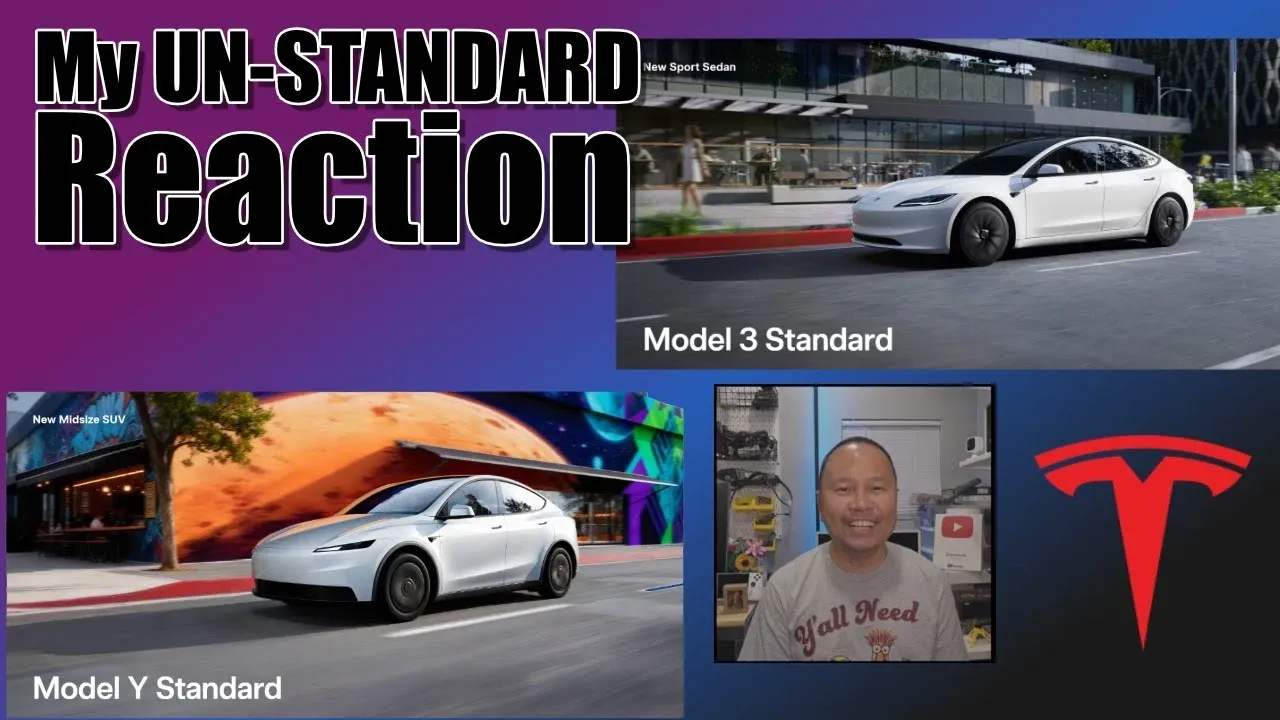
Tesla dropped the Standard trim levels for both the Model 3 and Model Y, and I’ll be honest, my first reaction was the same as everyone else’s: still too expensive. But then I actually ran the numbers, compared the competition, and changed my mind. Here’s why.
I wasn’t at the event. No press invite, no drive yet. This is purely based on the videos I watched, the Tesla website, and the specs I dug up. So take it for what it is: first impressions, no steering wheel time.
The Real Reason We Think It’s Too High
Here’s something I caught myself doing: I wanted the price gap between Standard and the trim I already own to be huge. Big enough to make me feel smart about the choice I made. That’s not a Tesla problem. That’s just how we’re wired. “I’m glad I didn’t wait” or “look how much more I got” is a psychological comfort, not a pricing reality.
So I forced myself to set that aside and look at what the actual competition looks like.
Model 3 vs. Nissan Leaf: The Closest Fight
The Model 3 Standard RWD starts at $36,990. The closest competitor I could find is the Nissan Leaf. Yes, the Leaf. Entry price is $29,990, but that’s the base trim. When I looked at what’s actually available in Southern California, the Leaf SV+, with the 75 kWh battery, was sitting at $36,330. And that’s the top trim.
At nearly the same price, the Leaf tops out at 288 miles of range. The Model 3 Standard hits 321. You’re paying roughly the same money and getting more range, plus everything that comes with owning a Tesla: the app, OTA updates, Supercharger access, and a software ecosystem that no other automaker is matching right now.
That’s not a bad deal.
Model Y Standard vs. Chevy Equinox
The Model Y Standard is $39,990. The Chevy Equinox EV LT1 FWD starts at $36,495, about a $3,500 difference. On paper that looks like a knock against Tesla. But the Equinox doesn’t have the Tesla software ecosystem, it doesn’t get the same frequency of OTA updates, and you’re not getting Supercharger network access.
Rivian does OTA updates well. Ford does some. But for consistency, frequency, and long-term support, Tesla and Rivian are in their own lane. And only one of those two is at this price point.
Think of it like the iPhone comparison: Tesla keeps supporting vehicles across multiple generations. I’m not confident the Equinox will be getting meaningful software updates five years from now.
Why Tesla Can’t Just Go Cheaper
People keep asking: why can’t they drop it further? I get it. But to actually move the needle on price, Tesla would have to start removing cameras. And the moment you do that, you lose FSD capability, you lose Sentry Mode, and you basically get an EV with a Tesla badge, not the Tesla experience.
The target buyer for Standard trim isn’t picking up FSD. A $100/month subscription is real money for someone buying at this price point. But the cameras aren’t there for FSD alone. They’re baked into the whole identity of what a Tesla is. Removing them isn’t a trim level decision, it’s a different product.
They kept what they could and lowered what they could. That’s the balance they landed on.
Three Things That Would Bump Me to Premium
That said, if I were buying today, here are the three things that would push me from Standard to Premium:
TPMS. The Standard trim doesn’t include it. Tesla calculates tire pressure differently. Since I’ve owned a Tesla with full TPMS readouts by tire, I can’t go back to guessing. My Kia has a generic low-pressure warning but doesn’t tell you which tire. Tesla tells you exactly which corner and what the reading is. That matters.
Matrix headlights. I didn’t fully appreciate these until I started driving the Cybertruck regularly, which doesn’t have them. Every time I get in the Cyber after driving the Juniper, I notice how flat the headlights feel. Matrix lighting is one of those features that’s invisible until it’s gone.
Adaptive damper suspension. The Juniper’s damper adjusts based on road frequency in real time, stiffening and softening as needed. It’s not air suspension, but it’s noticeably better than fixed dampers. I don’t know how the Standard rides without it, but it’s on the short list of things I’d miss.
And yes, someone online joked that even the Standard Model 3’s audio is probably still better than the Rivian premium sound system. Honestly, might be true. I won’t confirm or deny.
If you want to see the full breakdown after actually driving the Standard, I did get time with it a few weeks later: read that review here. And if you’re wondering what I ended up paying for the Juniper, I broke down every cost in this post.
Let me know what you all think. Did the Standard pricing land right for you, or does it still feel off? Drop it in the comments.
Leave a comment
Comments come straight to me rather than posting publicly, and I read every one. Your email is never published.