Not financial advice. Just the real numbers. Here’s everything I paid, stacked, financed, and got quoted for insurance on the Model Y Juniper.
Discounts I Was Able to Stack
The starting point was the inventory promotion. Tesla lets you pick one free option from a vehicle already on the lot. The highest-value option available gets credited as a discount. If the car had the 20-inch Helix 2.0 wheels, that would have been a $2,000 credit. For color, Quicksilver and Ultra Red sit at $2,000. I wanted Ultra Red, then Quicksilver. What was actually available was Pearl White Multi-Coat at $1,000. Abby wanted white anyway, so it worked out. Right after I selected it, every Pearl White Juniper was gone. Good timing.
On top of the inventory discount, I qualified for $1,000 through ID.me. Tesla offers this for military, veterans, educators, and first responders. If any of those apply to you, it’s worth checking before you sign anything. I also had a $500 loyalty discount as an existing Tesla customer.
The $7,500 federal tax credit is applied as a point-of-sale reduction. One thing to note: taxes are calculated on the pre-credit price. If the vehicle is $50,000, you’re taxed on $50,000. The $7,500 comes off after that. Keep that in mind when you’re running your own numbers.
The last one I almost left on the table: $483 sitting in my Tesla wallet from referrals. I had completely forgotten about it until after I’d already signed. It still got applied, but it was a close call. Shout out to everyone who has used my referral link.
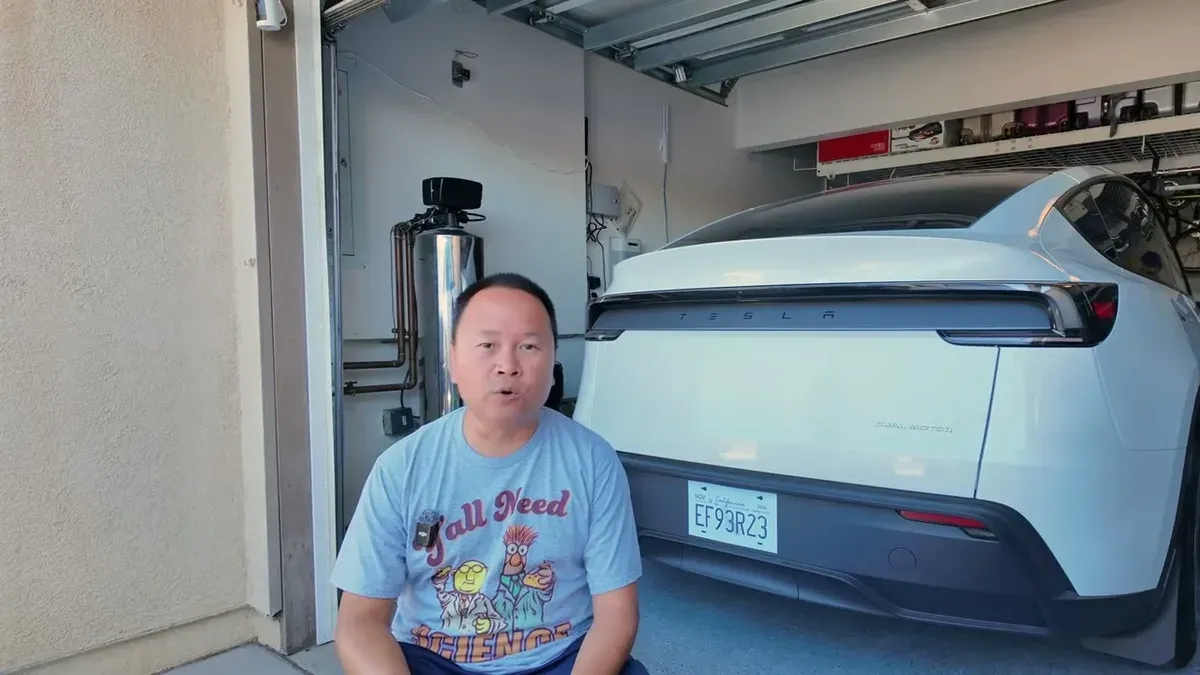
All of it together:
Lease vs. Finance
The lease quotes I received came in around an 8% equivalent APR. Monthly estimates were in the $500 to $700 range before taxes, which would push them closer to $600 to $800 all in depending on mileage tier. I was looking at 24 months. The problem: $600 to $700 a month for 24 months with no ownership at the end, a mileage cap I’d probably exceed, and the possibility of having to buy it out anyway if I wanted to keep it.
By comparison, financing at 3.49% over 60 months with $3,250 down made more sense. Total interest over the life of the loan is around $4,000. That’s the cost of the financing. When I ran the math on lease-then-buyout versus financing up front, the difference was about $2,000. I chose 60 months over 24 and own it from day one.
With the previous Model Y Performance, I paid cash and treated it as if I owed myself $1,200 a month. At today’s rates and terms, the gap between that self-imposed payment and the new monthly is meaningful. That’s money that can go toward paying the loan down faster, investing, or absorbing what California is about to do to my insurance.
Trade-In
The Performance was paid off. Trade-in value came back at $22,100. That’s a significant depreciation hit from what I paid, but I’m not surprised given how far Model Y prices have dropped. I took the minimum down payment of $3,250 from that amount and had the difference sent by check. It showed up just over a week after delivery. We put it toward some things around the house.
Before signing, I called my accountant to make sure there wasn’t a capital gains issue on the trade-in. He looked at the depreciation and confirmed we were fine.
The Buying Process
This one had friction. The Tesla app kept defaulting the down payment to the full $22,100 trade-in value instead of the $3,250 I wanted to put down. I couldn’t proceed to the financing step without resolving it, and I wasn’t going to hit accept on a $22,000 down payment by mistake. Getting it sorted meant time on Tesla’s chat and eventually a phone call with a long hold.
The financing approval process added another layer. I was initially seeing 4.49% offers from some of the banks calling to verify my identity. I wasn’t going to accept that. Eventually it settled at 3.49%, but it took a while to get there. Chase came up as one of the options, but I already lease the Rivian through Chase and they came back with a conditional offer that didn’t include the rate I needed. I ended up going with a different lender.
It’s not the cleanest experience. Situations that don’t fit Tesla’s automated flow require manual intervention, and getting there takes time.
Insurance
We’re in California. That context matters for everything that follows.
Before the Juniper, my three-vehicle total was around $723 per month: $184.16 for the Model Y Performance, $345 for the Cybertruck, and $168 for the R1S. That rate included a 3% discount.
After taking delivery of the Juniper, the breakdown shifted. The Juniper came in at $215.21, up from $184.16. The Cybertruck actually dropped to $340.51. The R1S held at $168.07. New monthly total: around $723 to $724.
The bigger change is coming at renewal on September 26th. The 3% discount goes away, and the new total jumps to $813 a month. That’s an $80 increase with no change in coverage. Tesla used to be the more affordable option for EV insurance in California. That’s no longer clearly the case. I’m looking at alternatives, including Costco, which is apparently writing policies in California again. A full video on that is coming once I get it sorted.
Overall
This is our seventh Tesla and our ninth EV overall. The Juniper is my daily driver. Most of the decision came down to comfort and utility on a car I spend significant time in every week. The FSD on Hardware 4 is noticeably better than what I was running on the Performance. The trade-in hit is what it is. The rate I got is good, and the discount stack going in helped.
If you want to see how the car performs day to day, the 10,000-mile efficiency test covers the real-world numbers. For what I’ve added to the car since taking delivery, the accessory compatibility post covers what carried over from the previous Model Y and what didn’t.
If you’re in the market for one, a Tesla referral link gets credits for both of us.
Leave a comment
Comments come straight to me rather than posting publicly, and I read every one. Your email is never published.