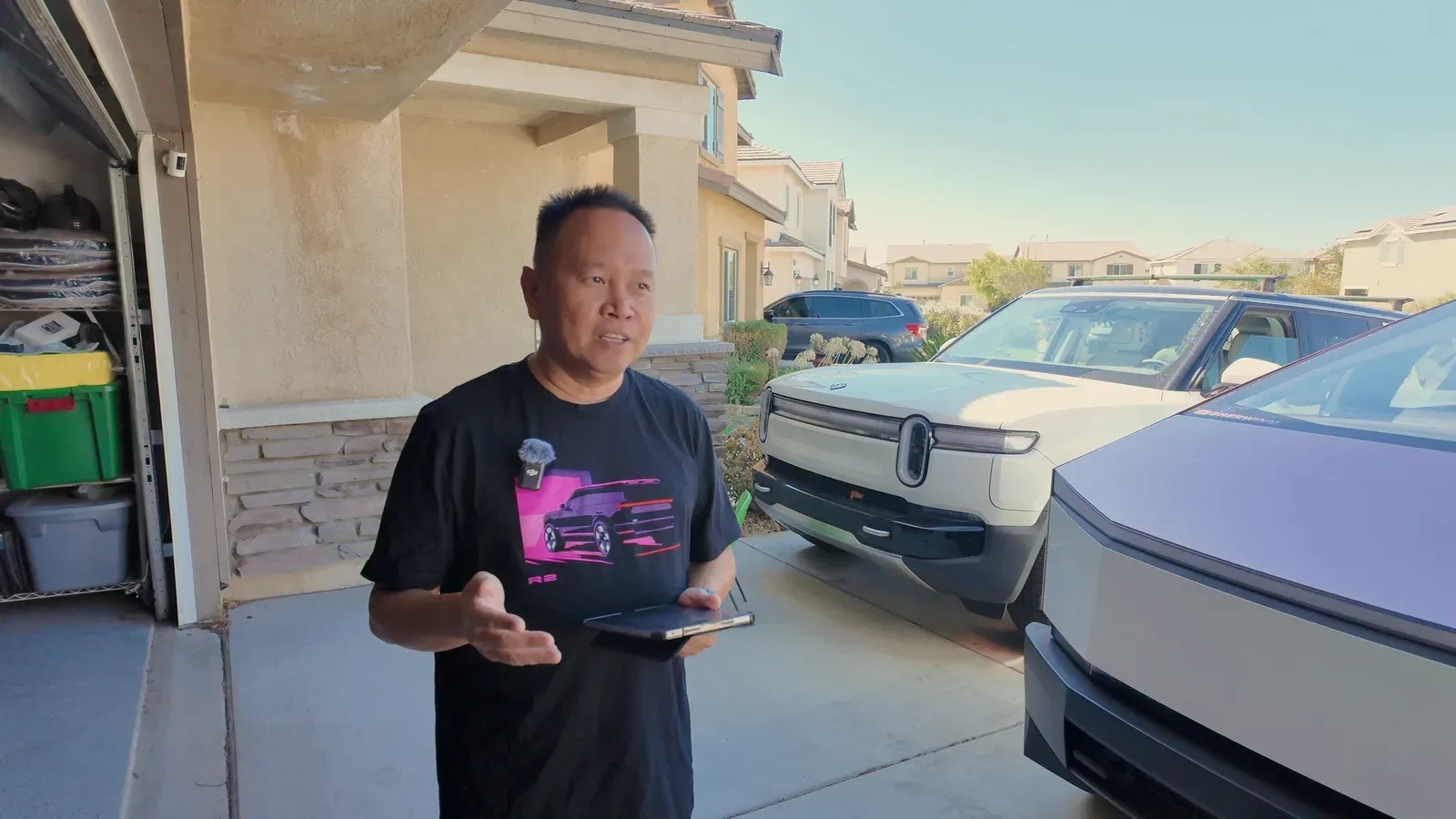
A couple of you asked the same question in the comments and I kept putting it off, so here it is. R1 vs Cybertruck, and I say R1 instead of R1S on purpose, because I’ve owned both versions. The T for the truck and the S for the SUV. I’ve also owned the Cybertruck for over a year now. Two of the three are still on my driveway, and the one that left is probably not the one you would guess.
I want to say up front how fortunate I am to have driven this many EVs. The best I can do with that is tell you honestly how they went, good and bad, and let you decide what fits you.
Why the R1T left, and what I kept instead
The R1T was the first truck I ever owned, and it happened to be electric. I loved it. It went because of the Cybertruck, and specifically because Abby didn’t want two trucks on the driveway. Guess who won that compromise. I went through the reasons back when I traded it.
That’s fine, because I’ve always said the best combination for us is the R1S and the Cybertruck. An SUV and a truck. The R1S is a better SUV for us than the Model X was, simply because it is more practical and there is more room. I don’t miss the Plaid performance either. Plaid is great, and I put 10,000 miles on ours, but that honeymoon ran out fast. What am I going to do, drive 140 miles an hour every day? No.
The R1S gives us real seven seater space, so my parents can come along on a road trip instead of driving themselves. They are retired and mostly want to stay home, so we haven’t done it as often as I imagined, but the seats are there when we need them.
The daily driver is neither of these. That’s the Model Y, because it is efficient and comfortable enough and FSD can’t be beat. I did commute in the Cybertruck for the first three months of ownership, when the free Supercharging came with it. Hold that thought, because it comes back later in this post with a bill attached.
R1S vs Cybertruck: the one I take on weekends
I can’t really put these two head to head, because they are two different vehicles. I have said before that the Cybertruck drives more like an SUV than a truck, which narrows the gap, but they are still not the same thing.
Between the two, I like my R1S more. It just feels more like a regular car. I want to drive it, and I get that feeling from the Rivian in a way I don’t get from anything else on the driveway. So on a weekend, if it is my choice, I take the Rivian. If Abby comes, we take the Cybertruck, because that’s her truck and there is a bunch of her stuff in it.
On road trips it is genuinely a toss-up. I like taking both. On my birthday we went to Vegas and I said we are taking the Rivian, because it is my birthday and those are my rules.
R1T vs Cybertruck: I switched sides
Here is where I changed my mind. In the beginning I always leaned toward the R1T. Now, after more than a year with the Cybertruck, I prefer the Cybertruck of the two, and it comes down to the bed.
The Cybertruck bed is much larger and the tonneau cover is included. On the R1T I believe the cover is optional, so you pay extra, and the early versions broke. They are on the third or fourth iteration now and I haven’t heard the same complaints, and it is a lot quieter than it used to be. My R1T never had one at all, so on road trips where it rained we threw a tarp over our stuff.
Fair warning on the Cybertruck cover: it is not waterproof. I’ve shown the leaks on camera. I don’t think Tesla markets it as waterproof either, but if you keep gear in the vault and you live somewhere wet, keep that in mind.
I said on camera that I would go look up the combined numbers, so I did.
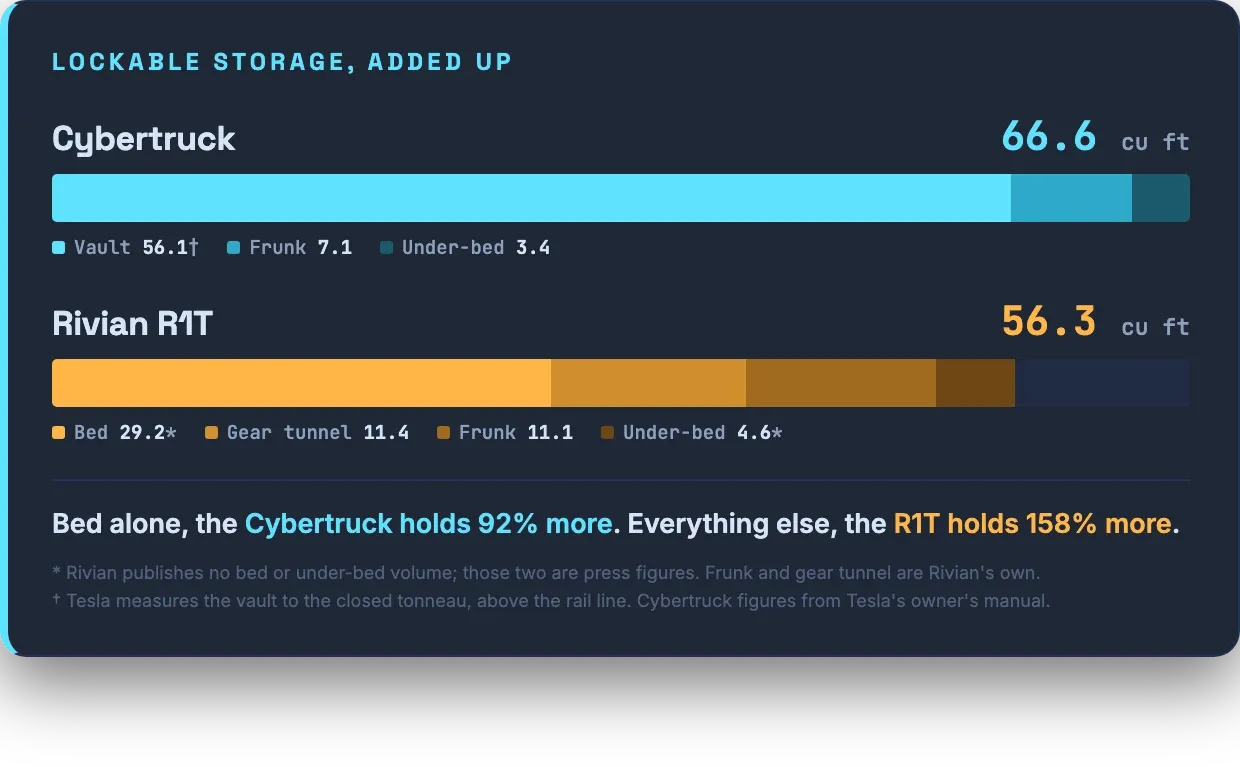
That’s the honest version of the argument. Bed alone, the Cybertruck holds about 92% more. Everything else, meaning the frunk, the gear tunnel and the under bed bins, the R1T holds about 158% more. The Cybertruck frunk really is not that big, and the gear tunnel is the thing Rivian owners rightly brag about. If you carry long or dirty items, the Cybertruck wins. If you carry a lot of separate things you want organized and locked, the R1T wins.
There is also a 220 volt outlet in the Cybertruck bed. I’ve never used it, but I like knowing it is there. I believe the R1T is 120 volt only.
For off-roading I’ve taken the R1T out more, and fun fact, it was never on all terrain tires and it still handled everything I pointed it at. Nothing too crazy, but I was impressed. The R1S is on the 22 inch wheels with the Pirelli Scorpions that everybody complains about, and so far, fingers crossed, no issues.
I also said on camera that I couldn’t remember whether the R1S has locking differentials. It doesn’t.
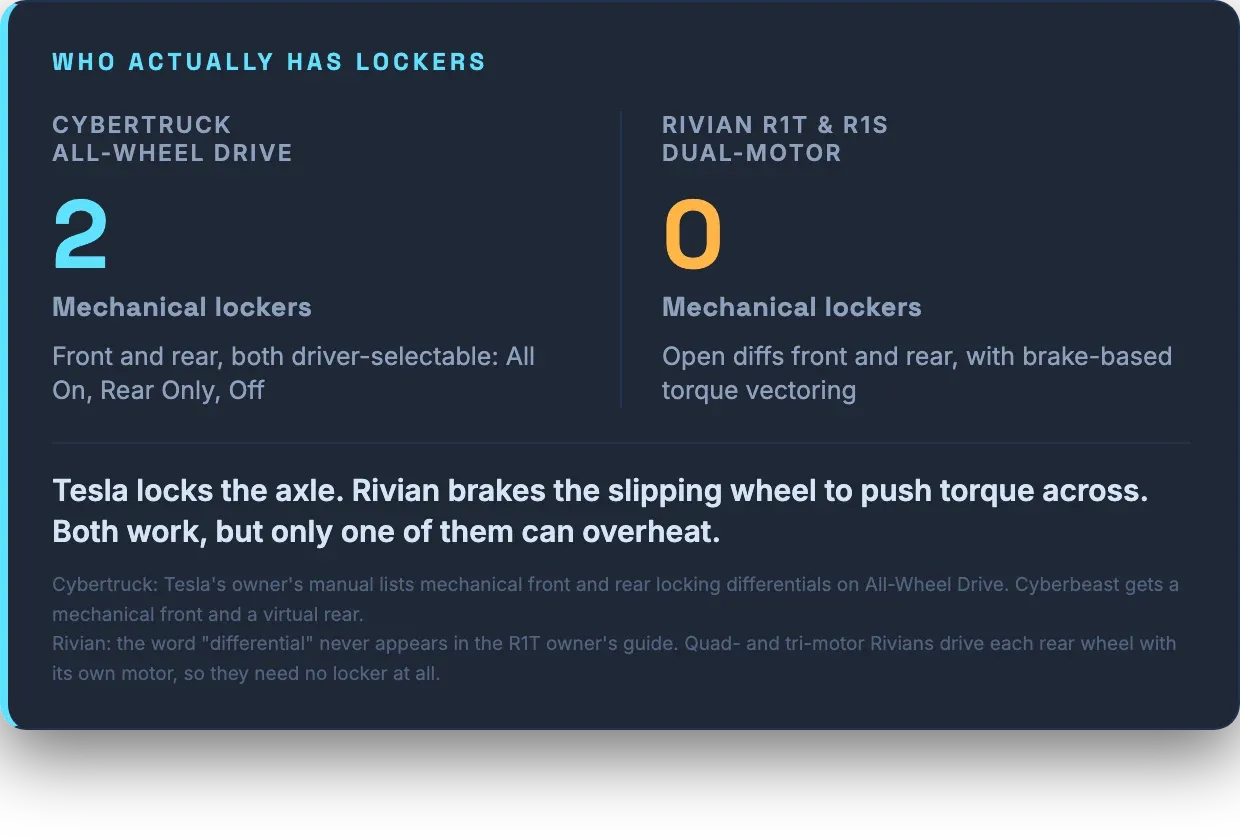
Tesla locks the axle. Rivian brakes the slipping wheel and pushes torque across instead. Both approaches work, and I still lean toward the Rivian software for off-roading. We don’t go anywhere complicated enough for it to decide a day out. There was one climb where my friends continued up in a Hummer EV and Kobra went with them in his Cybertruck, and it worked out fine for them. I sat that one out.
If you want the full, dedicated R1 vs Cybertruck video, tell me in the comments and I will make it.
The charging session that changed my mind about the problem
I’ve been complaining about Gen 2 R1S DC fast charging for a while. Then, in the 14 month review, the car pulled 220 kW at 28% in 113°F heat and made me eat it on camera. So I charged again on September 4, same location, same stall, and documented the whole thing.
| Aug 28 review session | Sept 4 | |
|---|---|---|
| Arrived at | 24% | 21% |
| Energy added | 71.45 kWh | 72.92 kWh |
| Time | 36 min | 45 min |
| Average rate | 118 kW | 97 kW |
| Peak | 220 kW | 217 kW |
Look at where the difference is not. The peak is basically identical, 220 against 217, and I started at a lower state of charge the second time, which should have helped me. I still added 2% more energy and it took nine minutes longer.
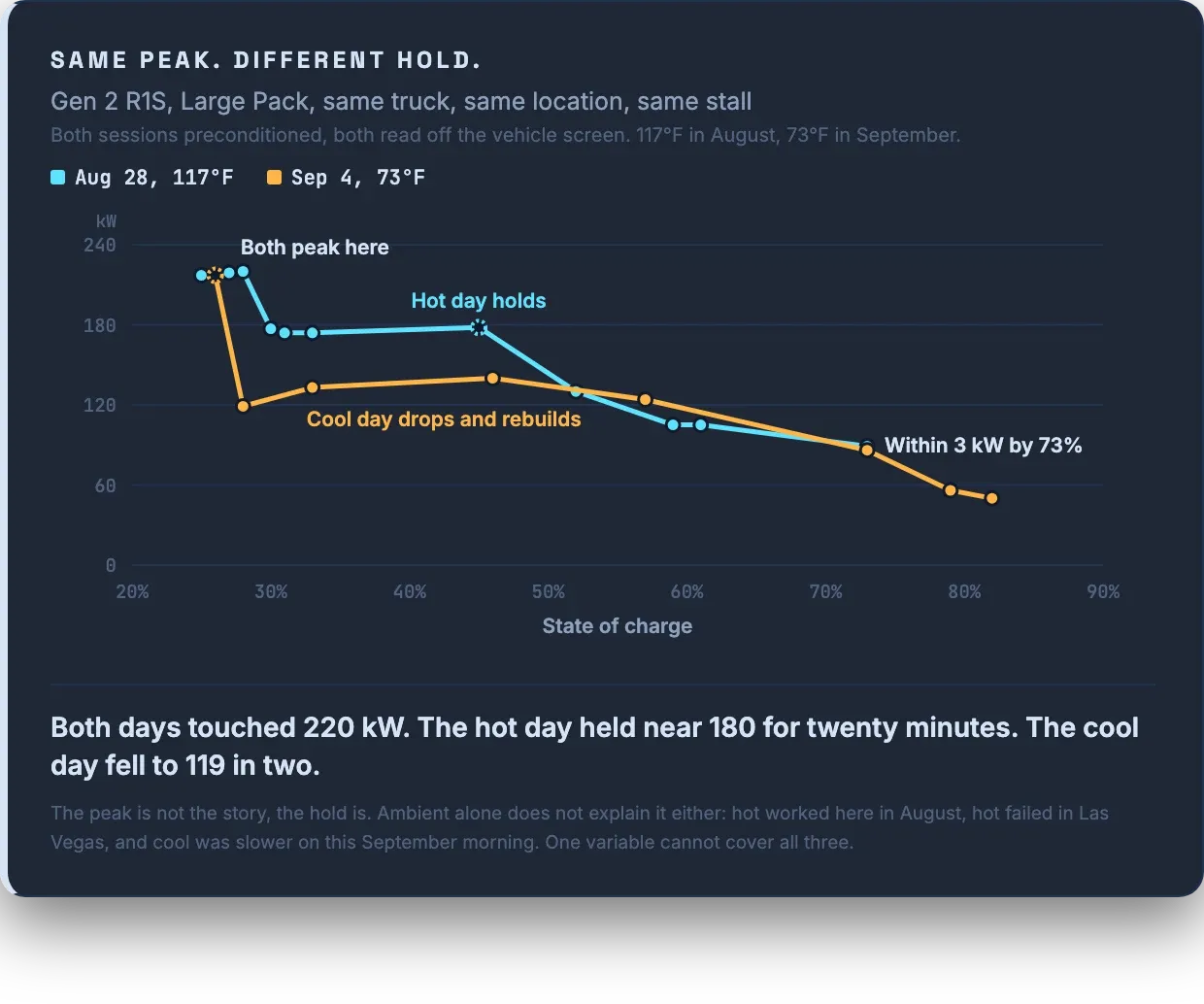
The peak is not the story. The hold is. The hot day sat near 180 kW for about twenty minutes. The cool day dropped to 119 in two, then rebuilt. That’s what I’ve been feeling on road trips without being able to name it. It will touch 215 to 220 for maybe a minute or two, then plummet to 130 or 140.
Temperature alone doesn’t explain it either. Hot worked here in August. Hot failed in Las Vegas. Cool was slower on this September morning. One variable can’t cover all three.
So I don’t have a clean answer, and I am not going to invent one. What I do is plan around it. On road trips I stay above 40% state of charge. This car doesn’t seem to benefit from a deep charge the way my Gen 1 R1T did.
If you own a Gen 2 and you are seeing something different, tell me. Genuinely, make me feel better about it.
Three red blinks, burned tips, and a $320 fix
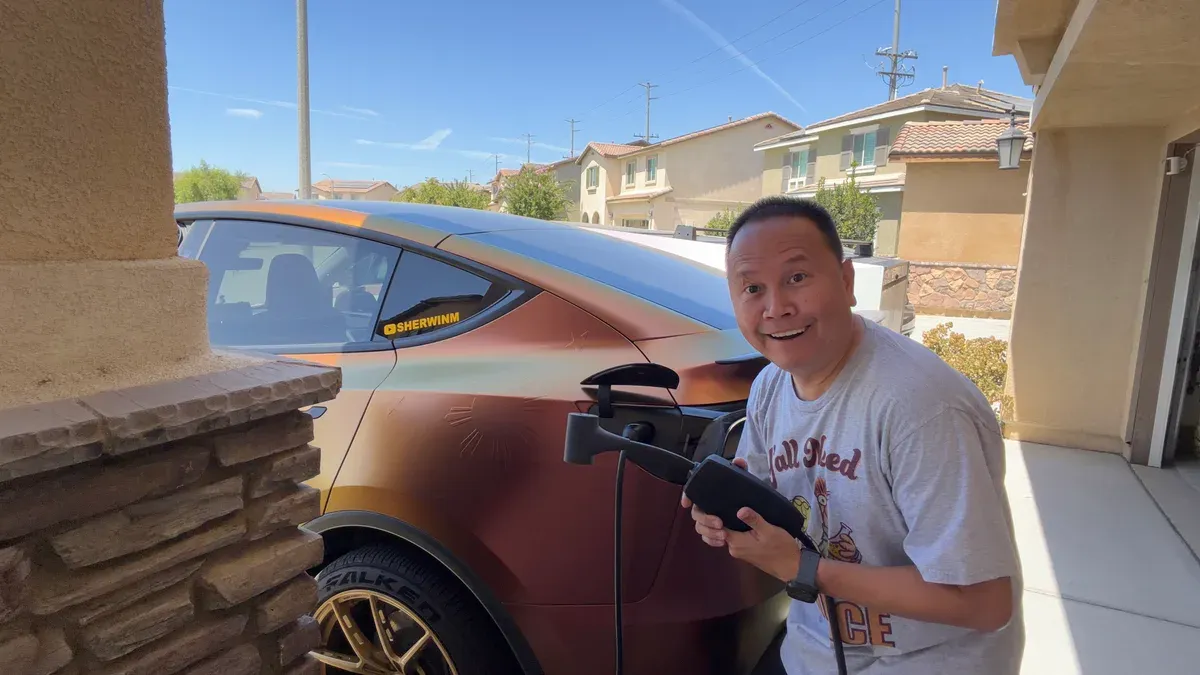
The Tesla Wall Connector in my garage has given me three red blinking lights in the summer for a few years now. Three red blinks means high temperature, and what happens is the car asks for 48 amps and the connector cuts it to 24. I had gotten used to ignoring it, because it always went back to green.
Then a few weeks ago I got a notification that charging had stopped because of a voltage drop. That’s a different thing. I looked it up and the answers all pointed at a loose or corroded connection, and a loose connection can arc, and an arc can start a fire. So I shut the breaker off instead of waiting to see what happened, and I called an electrician. A different one this time.
That second one is the message that changed this from an annoyance into something I turned the breaker off over.
He opened it up and the tips were burned. The terminations, right where a loose or overloaded connection cooks itself.
Here is what I learned. The wall connector pulls 48 amps at full power, and for that Tesla’s own installation manual calls for a 60 amp breaker with 6 gauge copper. Mine was on a 70 amp breaker. My previous electrician had told me that was fine, because the car only ever asks for 48. The problem is that the breaker was allowing the circuit to pull more than the wire and the connections were rated for. That’s how you get burned tips. Dropping to 60 was not the new guy cheaping out on me. 60 amps is what it should have been on the whole time.
The ground was 12 gauge too, which is undersized for a circuit that size. NEC Table 250.122 calls for 10 gauge on a 60 amp circuit, so that got replaced as well.

I also asked what other work would run. A NEMA 14-50 install would be $650 including the plug. A second wall connector would be $550, though the connector itself is another $500 or $600 on top. With three EVs I am thinking about it. Right now I can only really charge one car a night, and I don’t like getting up at 2am to swap. In the meantime I trickle charge on a 110 outlet, usually the Cybertruck for a few days on the weeks Abby is not driving it.
It is not actually fixed
The rewire solved it for the Model Y and the Cybertruck. It didn’t solve it for the Rivian, which charges through an A2Z adapter. That combination still triggers the red blinks and still drops the amps.
Heat is not the variable, because the weather is the same for all three cars and only one of them faults. The difference is the adapter. Every adapter you add puts two more metal connections in the path, and every connection is a place heat can build up. Next time it faults I am going to go put my hand on the adapter and find out whether that’s the hot part.
The garage doesn’t help. It faces west, and from about 2pm on, the sun targets that wall. My breaker panel and solar equipment are right there, cooking. Charge at 9pm or at 6am and I have no issues at all, 48 amps, no complaints, even back when it was on the 70 amp breaker. It is only the afternoon and early evening. We are on Edison’s time of use 4 to 9 plan, so I schedule charging for 9pm anyway. That is right when the garage is still holding the day’s heat.
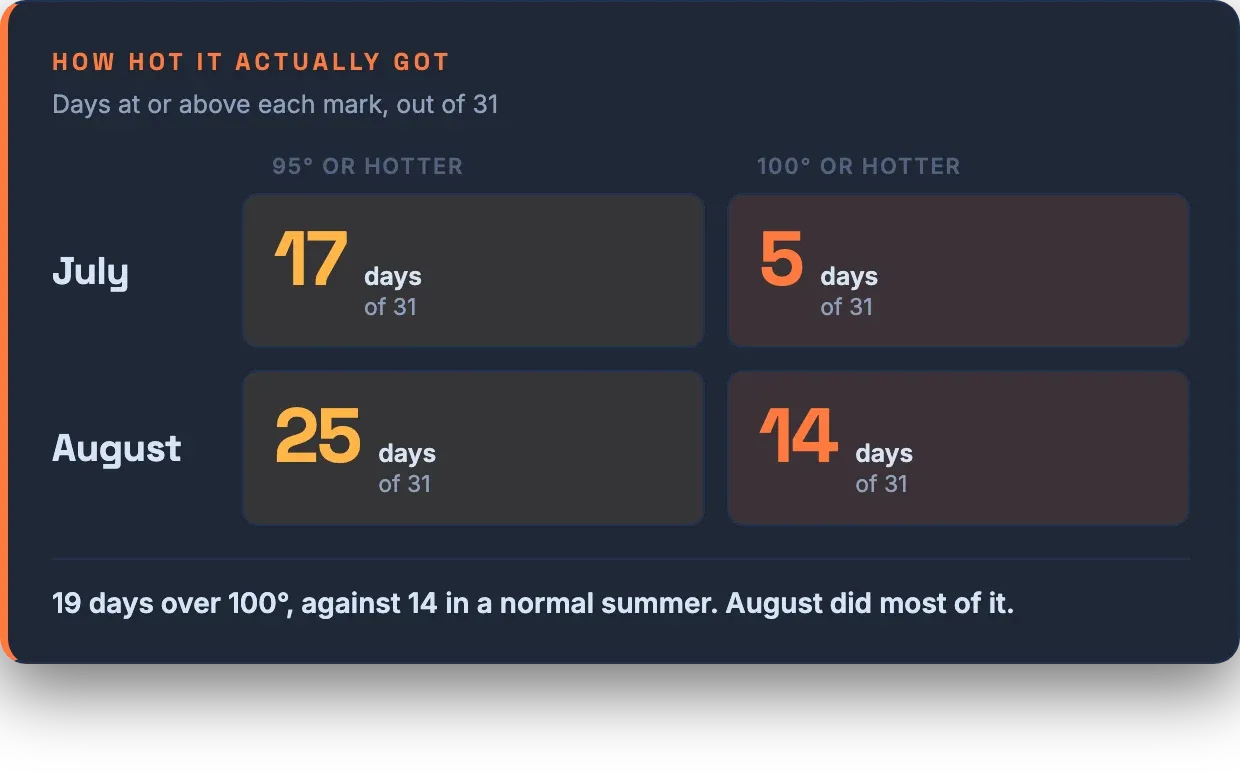
And the heat was real this year.
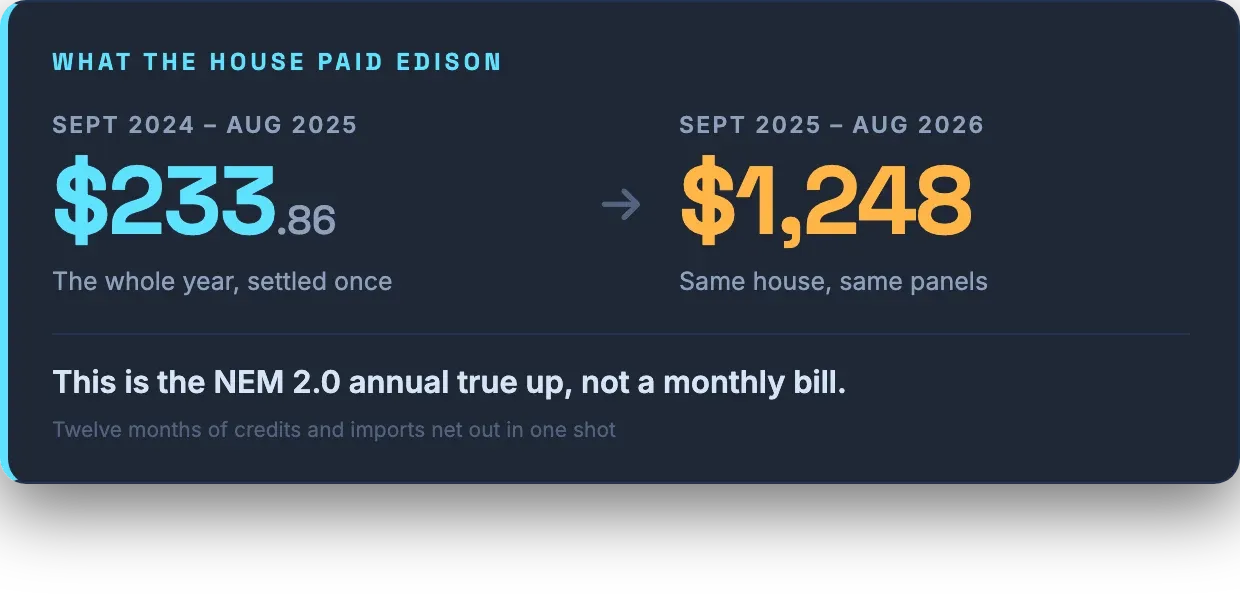
Why my Edison bill went from $233 to $1,248
This one deserves the most explanation, because the number looks worse than it is.
We are with Southern California Edison on NEM 2.0, which is net energy metering. We don’t pay monthly. The credits and the imports settle once a year, and our cycle starts in September, so this is the annual true up.
We have 35 panels across two arrays, 11.58 kW total. Twelve came with the house. We made the mistake of leasing those without doing our research. The other 23 we financed and then bought out early, to stop paying interest on them. Together they cover about 89% of what the house uses.
It is never zero, even when we are exporting. Connection fees, generation fees and taxes get charged on the kilowatt hours you pull, regardless of what you send back. That runs about $25 to $32 a month on its own.
Now the number that actually explains the jump.
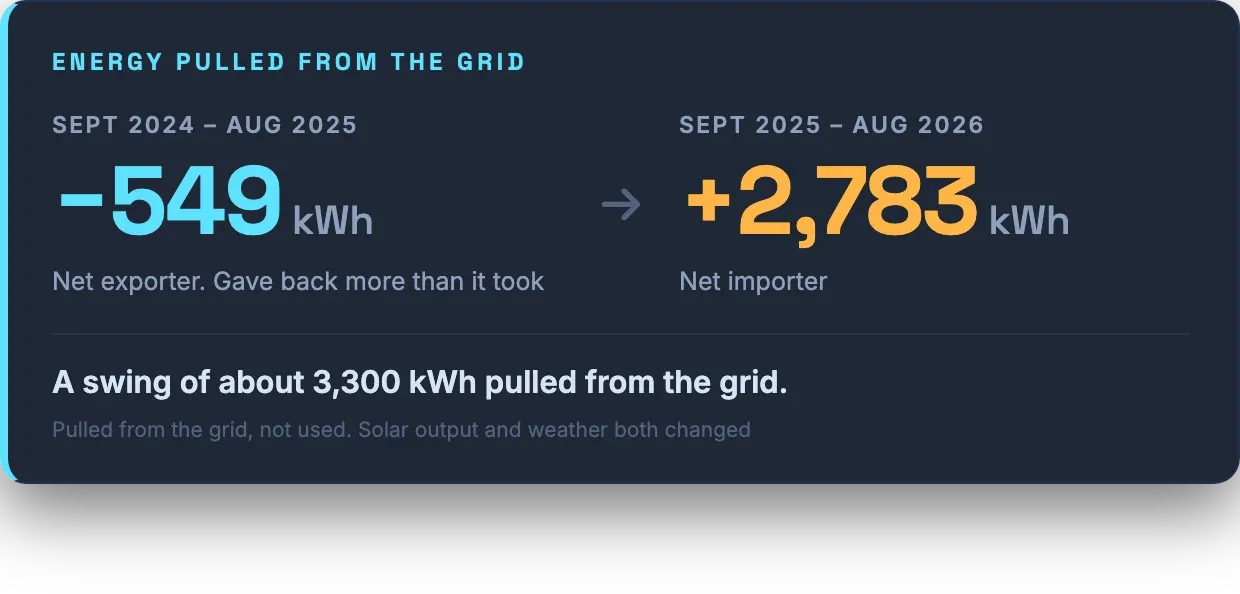
I want to be careful how I say this. That’s a swing of about 3,300 kilowatt hours pulled from the grid, not used. Our consumption may be close to flat. Solar output and weather both moved too. What changed is where the energy came from.
The rate increase was about 1%, roughly $6, so that’s not the story either. Everybody’s first guess is that Edison raised rates, and this time they basically didn’t.
The real cause is that the Cybertruck’s free Supercharging ended, so that charging moved onto the house.
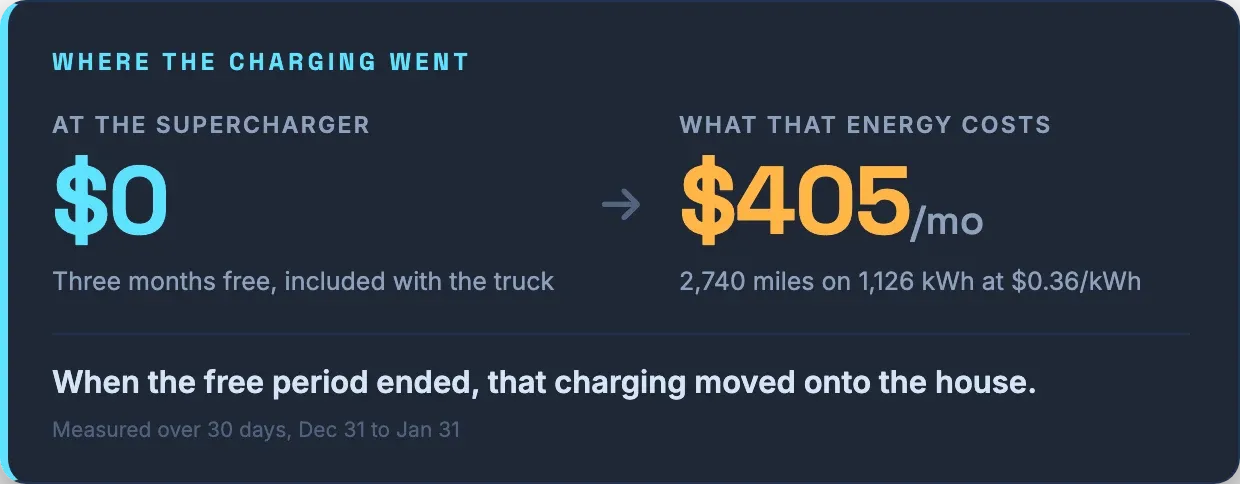
For scale, this house averages about 59 kWh a day including charging the cars at night. A Cybertruck pack is around 120 kWh. So filling one from near empty is close to two full days of everything else in the house, every light, both air conditioners, the fridge, all of it. Most nights I am putting back roughly 40% of a pack, which is still a lot.
Two honest caveats. August was genuinely brutal and the air conditioning ran hard, so some of that 3,300 is weather and not cars. And I can’t split the two, because nothing in this house meters the charger separately from everything else.
The R1S is barely on this bill at all, because it mostly charges free on the Rivian Adventure Network, thanks to people using my referral link. So the car that moved this number is the Cybertruck, and the thing that moved it was a perk ending, not a habit changing. If you want the longer version of how we ended up charging everything at home, I wrote that up when we transitioned to home charging and solar.
The rest of the summer
The Tesla summer update landed along with FSD 14.3.8. It is starting to remember my preferred routes, which is what I asked for in my video about why I can’t run 100% FSD. My pet peeve got worse though. It waits until the last 0.2 to 0.3 miles to change lanes for a turn or an off ramp, on both the Model Y and the Cybertruck. I fix it with the turn signal, but if I have to do it manually then where is the automation.
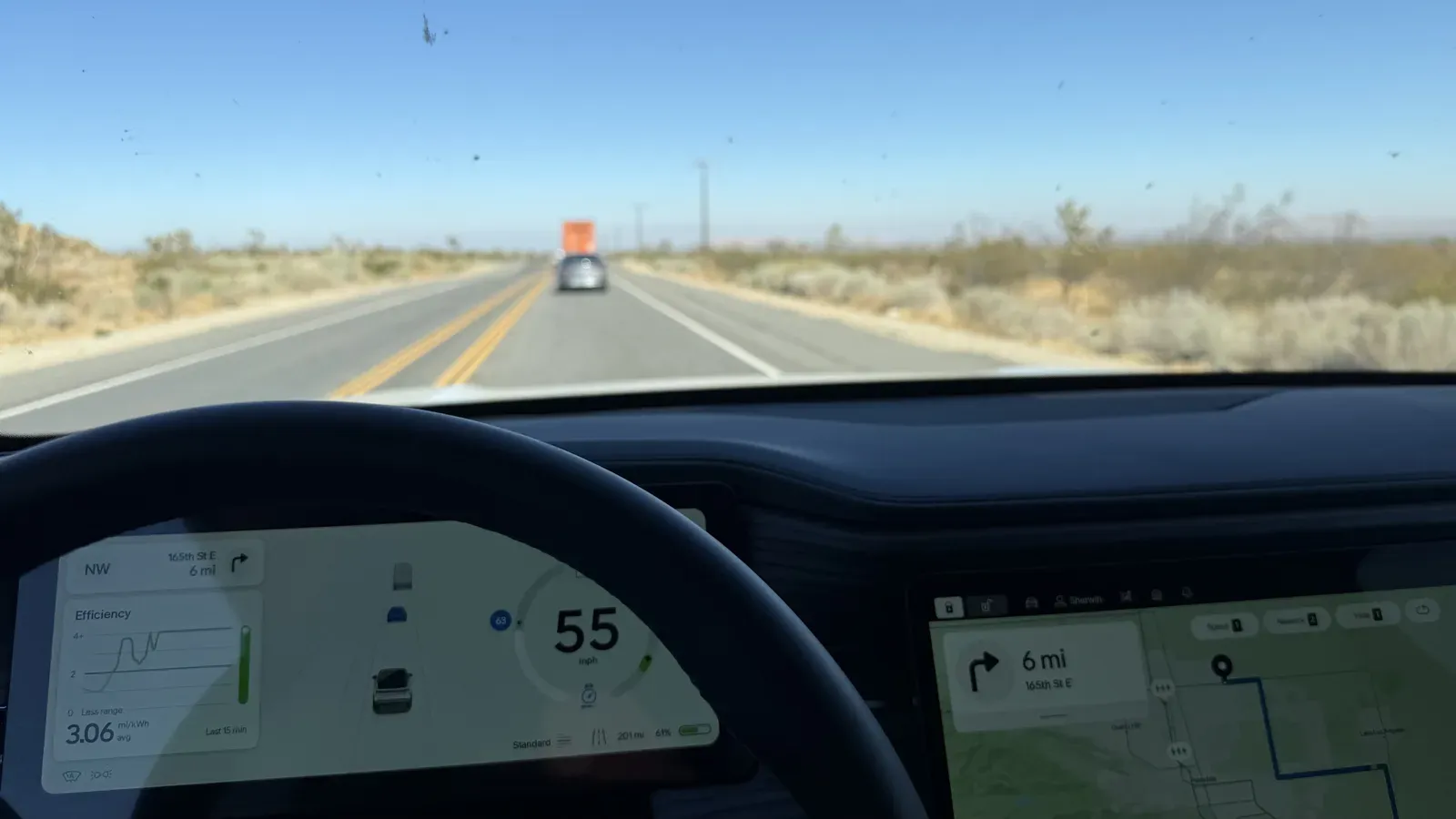
I took the R1S to Palmdale hoping to use hands off driving and couldn’t, because it is not a mapped highway. Enhanced Highway Assist and Highway Assist both live under the Rivian Autonomy Platform and both are highway only, so out there I ran plain adaptive cruise control. It handled speed and following distance fine, but those smaller highways have stop signs and lights, and as of September 2026 it will not stop for either.
 There is supposed to be a point to point update by the end of the year. It is September and I haven’t seen any notes. If it lands, I will think harder about the $49.99 a month Autonomy+ plan.
Cybercab had its event on September 3, and I filled out the interest form under my business. Fleet of one.
 My work only gives me two remote days. If I have to drive in anyway, I would rather the car earn something while I am sitting at my desk. I also rode in a Waymo for the first time in Orlando. Honestly, if you have used FSD, it is not the shock people make it out to be.
Closer to home, I went to Surge at Sunset on August 30 at the Ontario Mills Superchargers, hosted by our friend Tesla One. It was actually near our house for once, so Abby came and we brought the Juniper and the Cybertruck. There were light shows with the Cybertrucks and then with the rest of the Teslas.
Away from cars, Abby turned 50 and I learned to dance for it. Dancing is not my thing. She was surprised and happy that I did it anyway. We also spent a few weeks in the Philippines, where Abby’s grandmother passed away at 96. We got to say goodbye. The first time I ever met that side of the family, I was stranded. It was pouring, the power was out, and nobody answered the door at my mom’s house. She offered me a place to sleep and treated me like one of her own grandkids. So, goodbye Mama Gavina, and thank you for everything.
My oldest also got his driver’s permit, which started me thinking that he may never drive a gas car. Every vehicle we own is electric. When it is time, I am leaning toward a used Model 3. I’ve owned one, I know it is safe, and I can keep an eye on it. What would you get your kid as a first car?
Where the channel is
August 2 I hit 4,000 subscribers, and August 22 the channel passed 2.1 million lifetime views. Some channels do that in a single video. That’s my entire history on this one, and I am grateful for all of it.
July was the best month of the year at 82,330 views. Half of that was two videos, the Model Y L and EV Fest, at roughly 21,000 each. What scratches my head is that my other EV Fest and event videos don’t do those numbers. If you like that kind of thing, go dig through the road trips and events playlist. There is a lot of it sitting there.
This is not my day job, and that’s on purpose. My day job pays for the cars, the insurance and the payments. YouTube revenue doesn’t come close, and it is not supposed to. It means I get to tell you the good, the bad, the ugly and the truth. I am aware that is probably part of why the channel doesn’t grow faster. If growing faster means changing how I frame things, I would rather not.
I am also starting a third channel, Famously Small, about what it is actually like to be a small creator. Monetization, the pressure that comes with brand deals, the gotchas around taxes when the 1099 shows up on all that free stuff. Same approach as here, nothing held back. The channel exists, there is nothing on it yet, and the link is in the video description.
Coming up: Toyo Tires at Big Bear, the Zero Emissions Run at the end of the month, and Halloween events. I will probably be Gear Guard Gary again, because I paid for that costume and I intend to get my money’s worth.

Leave a comment
Comments come straight to me rather than posting publicly, and I read every one. Your email is never published.