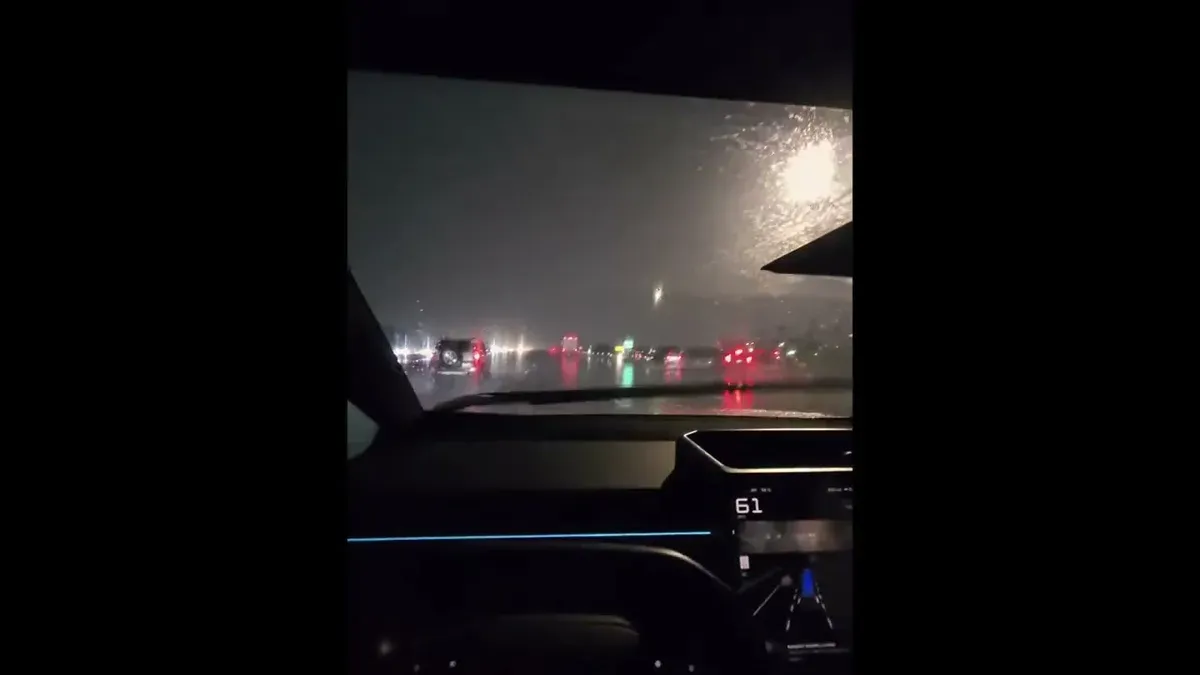
SoCal finally got rain, and my first instinct was to take the Cybertruck out with FSD running. V14.1.7 was loaded up, the update that also added 3D buildings and Tron Mode. It was dark, it was wet, and I was heading to basketball. Footage is from the Meta Oakley glasses, so the angle moves around. That’s on me: supervising FSD in those conditions means your eyes are everywhere.
Here’s what I noticed over about ten minutes of real highway and surface street driving.
The Wipers and Camera Notifications
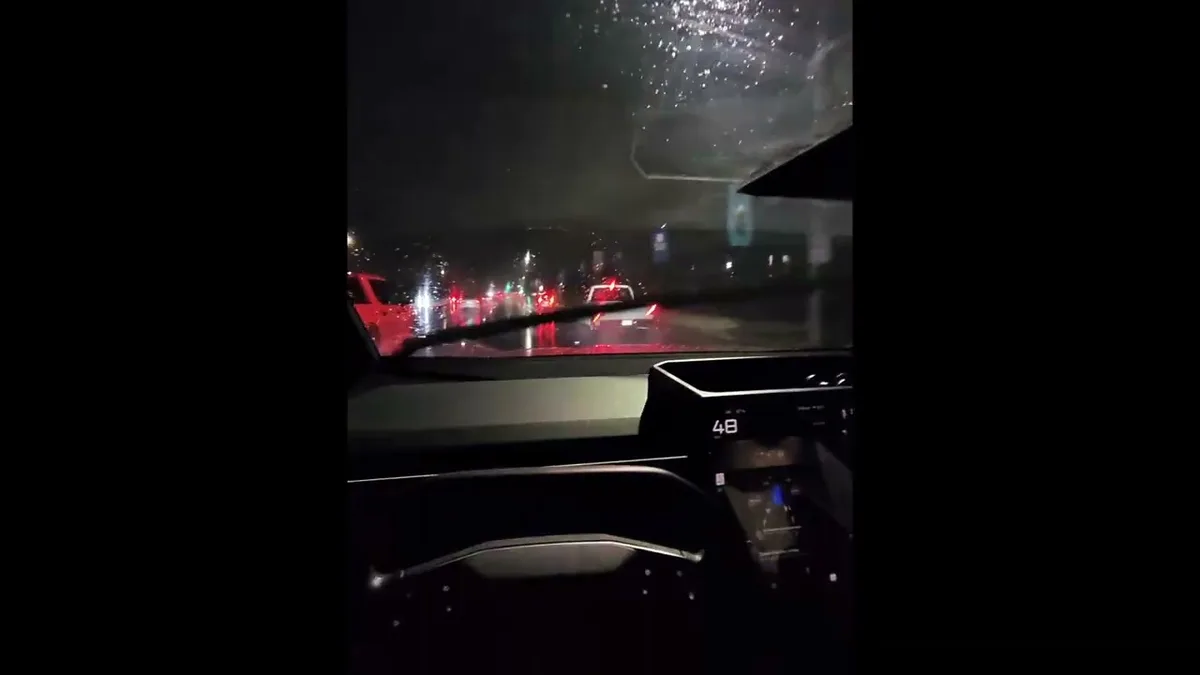
The first thing I noticed when FSD took over was the wiper speed. When FSD is active in rain, it runs the wipers faster than it would if you had them on auto manually. Not full blast, but noticeably more aggressive than what I’d set myself. That’s new behavior compared to what I’ve seen in previous versions.
I also got repeated “camera visibility limited” notifications throughout the drive. Both the Model Y and the Cybertruck have been throwing those this past week with the wet weather. FSD doesn’t disengage when it gets them, but it does log them and the system clearly knows its own limitations in those moments.
Speed and Profile Behavior
FSD automatically reduced the maximum speed once it detected the weather conditions. Each profile has a speed ceiling, and in rain it brings that ceiling down. What I didn’t expect was a trick I discovered: if standard profile is running too slow, you can bump up to Hurry, let it settle at the speed you want, then drop back to standard. It holds that speed instead of slowing back down. That’s useful when standard decides to sit in the left lane at 58 on an open freeway.
Reading Lanes in the Rain
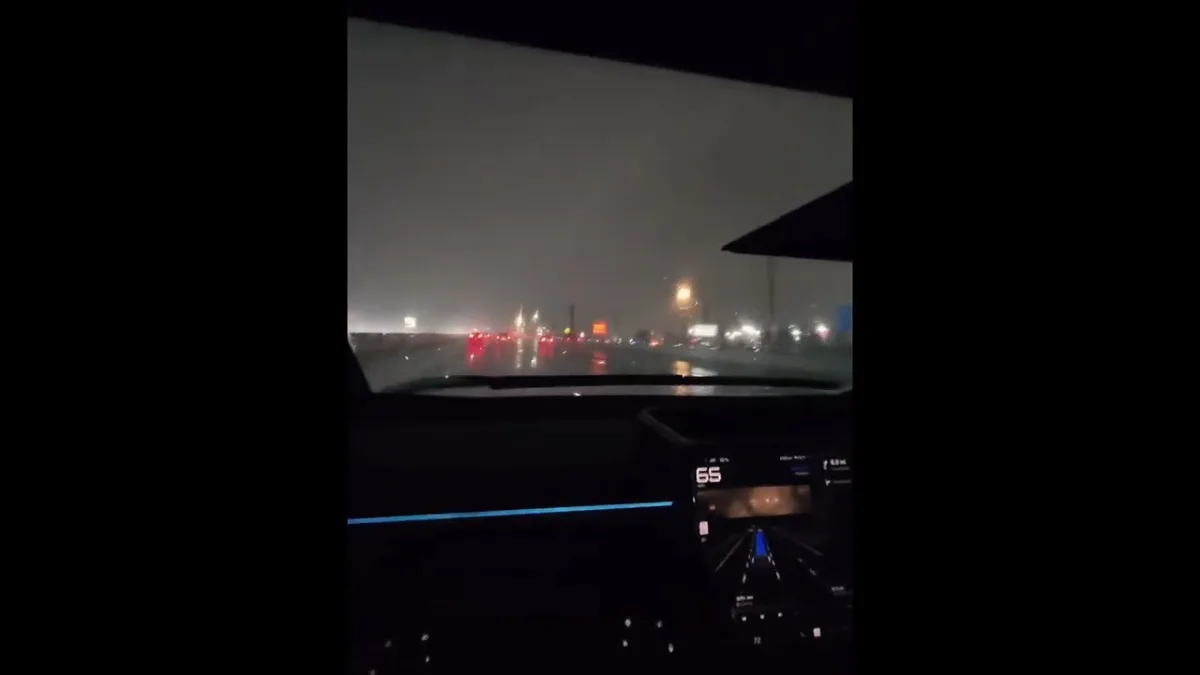
Lane detection gets harder in the rain because street lights and traffic signals reflect off the wet road. The lines blur or disappear entirely in the glare. What I think FSD does in those situations: it detects whichever lane line is more visible, then uses measurements to estimate the position of the other side. I’ve watched it draw a clean lane even when only one boundary is legible. It’s not perfect, and there were a couple of moments where it drifted toward the left edge before correcting, but it caught itself each time.
This stretch of road had construction coming up. Cones narrowing two lanes on the left, and the lane I was in converted to left-turn only. FSD read the signs, read the cones, and moved into the correct lane without any input from me. That’s the kind of real-world navigation that actually matters.
Following a Semi in the Rain
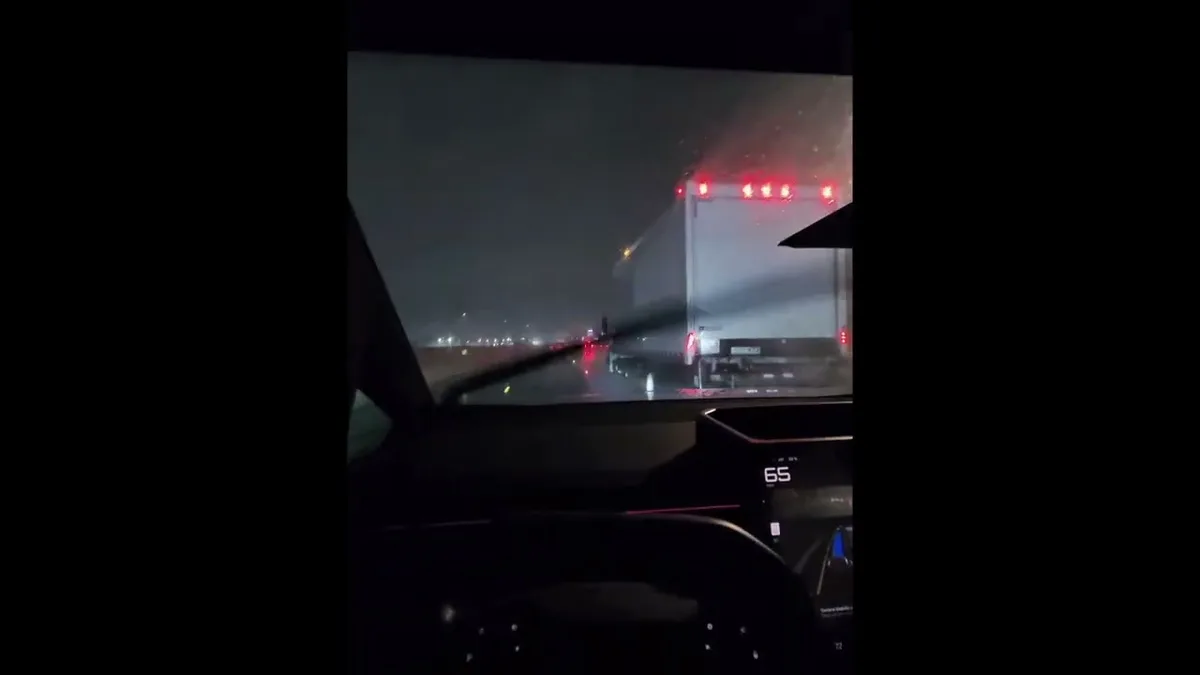
For a stretch on the highway I was sitting behind an 18-wheeler at 65 mph in the rain. FSD held position and maintained distance without drama. The reduced speed ceiling meant it wasn’t trying to push around the truck aggressively, which was the right call given the conditions. No phantom braking, no sudden lane changes. It just drove.
Where I Had to Step In
Toward the end of the drive, a Toyota Corolla ahead threw on its hazard lights. The Cybertruck detected it and changed lanes around it. Then the Corolla turned the hazards off, the Cybertruck was now parallel to it, and right at that moment the Corolla’s trunk popped open. The trunk opening is an obstacle. The Corolla threw its hazards back on. The Cybertruck started to react, didn’t fully commit to a decision, and began tapping the brakes. I took over.
That was the right call. It wasn’t a catastrophic failure, but FSD got caught in an ambiguous situation: is the car changing lanes, is the trunk an obstacle, does it need to give more space? It hesitated. I was glad I was watching.
The Verdict on v14.1.7 in Rain
FSD v14 has been a real improvement over v13 in daily driving, and this wet-road test reinforced that. On the SEMA road trip in the Juniper I noticed similar gains in lane-change behavior on v14.1.4. V14.1.7 on the Cybertruck in rain feels like another step forward. It handled a construction merge, held a lane in heavy rain, detected a vehicle with hazards and moved around it, and automatically managed its own speed for the conditions. Most drivers would’ve done the same things, and some would’ve done them less smoothly.
That said: one hand was on the wheel the entire time. On a clear sunny day I’m more relaxed with FSD. In rain, at night, I’m treating it as a copilot that needs supervision, not an autopilot I can disconnect from. That’s exactly how Tesla describes FSD Supervised, and this drive was a good reminder of why the “Supervised” part is in the name.
If you’ve run FSD v14 in rain, let me know what your experience has been. Results seem to vary a lot by region and road conditions, and I’m curious whether SoCal’s freshly rained-on roads are harder or easier than what folks deal with regularly in Seattle or the Pacific Northwest.
If you’re picking up a Tesla, use my Tesla referral link.
Leave a comment
Comments come straight to me rather than posting publicly, and I read every one. Your email is never published.