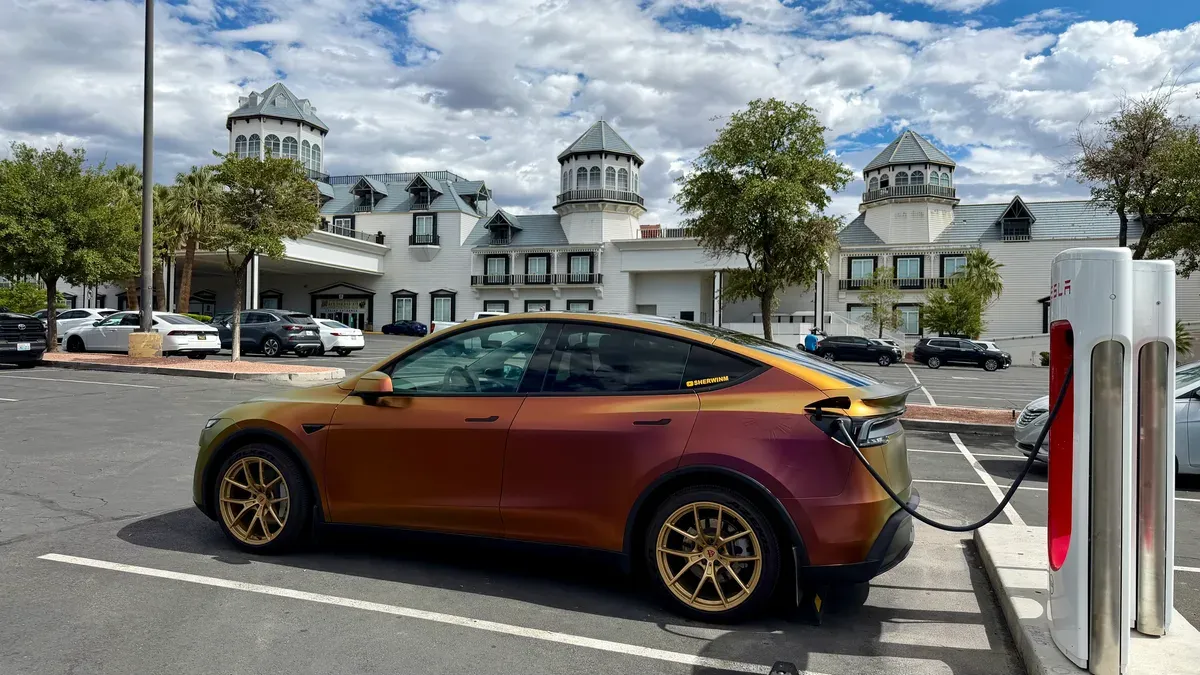
522.7 of 532.2 miles drove themselves. That is 98.2% FSD usage on an overnight run from SoCal to Las Vegas and back, running FSD 14.3.8, and I still could not get to 100%. The 9.5 miles I had to take over myself are the interesting part.
My nephew was flying into Vegas from Detroit with his wife, so I booked a room, drove out to take them out for a night, and drove home the next day. A round trip with charging stops, a hotel, the Strip, and a gated neighborhood is a much harder test than a commute.
Measuring FSD 14.3.8 on a real road trip
Tesla shows you a lifetime percentage under FSD Supervised stats. Mine went from 73% to 74% across the whole trip, which tells you nothing, because it is averaging every mile I have driven since I got the car.
So I photographed the stats screen before I pulled out, again when I got to Vegas, and again in my driveway. Subtract the readings and you get the trip.
The drive out was 97.5%. The drive home was 99.0%. Together, 98.2%.
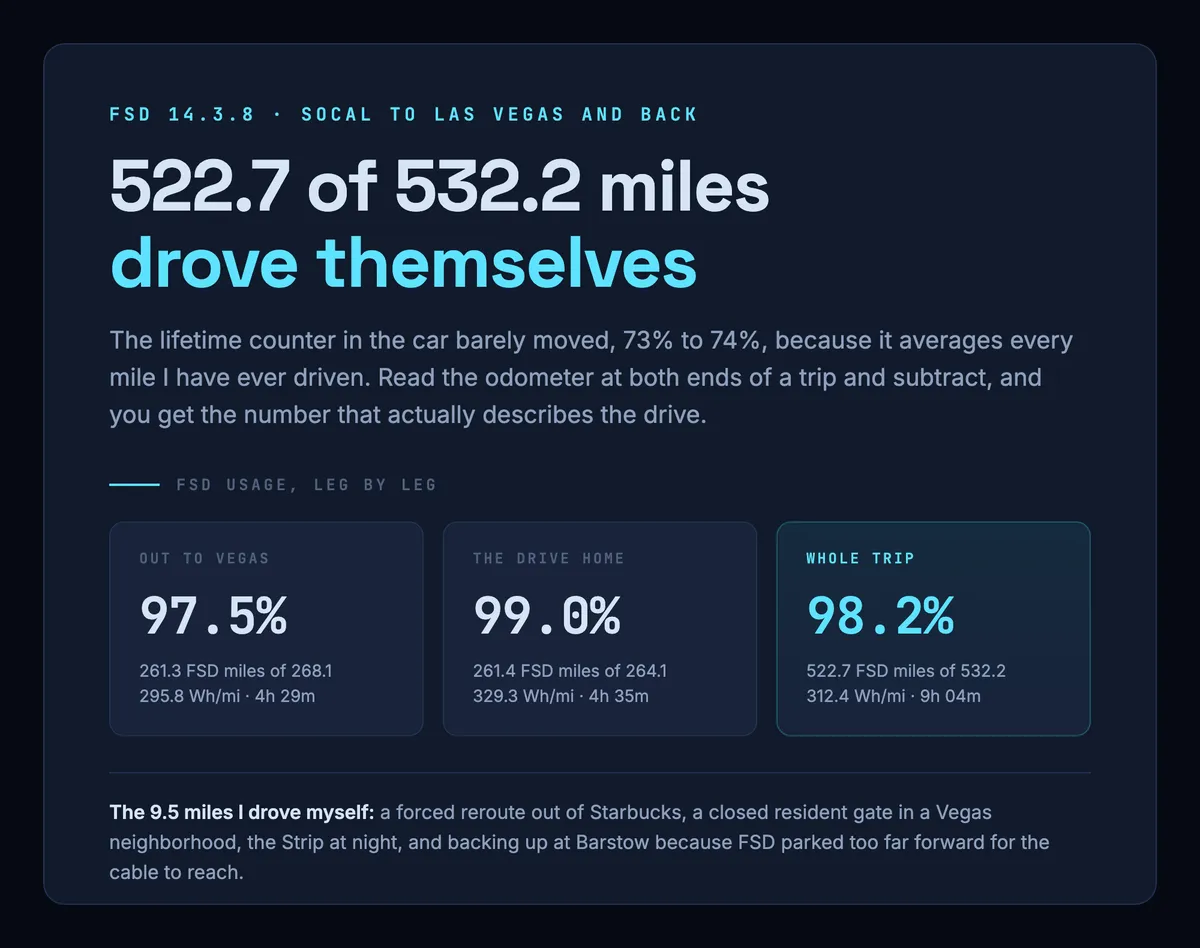
Anyone can do this. It takes two photos and it is the only way to talk about FSD usage on a specific drive instead of a number that has been diluted by a year of parking lots.
Where FSD 14.3.8 still needs me
Routing is the first thing that breaks. Leaving Starbucks, the nav wanted a diagonal out to one freeway, over to another, then north, when I could have driven straight up the street and gotten on there. Zooming out never offered me an alternate route to pick from, so I had to disengage, drive past the original on-ramp until the car noticed, and let it recalculate. That forced reroute saved about 3 miles. Same thing at my nephew’s brand-new gated community in northwest Vegas: the nav sent me to a resident-only gate that was closed, with no alternate route offered, so I drove it in manually.
Then there is the left lane. FSD 14.3.8, and 14.3.7 before it, likes to sit in the far left lane of the freeway at 72 mph. In California that is a great way to make everyone behind you hate you. I am constantly flipping the turn signal to get it to move over.
People tell me in the comments to just use the signal, and I know how to use a turn signal, I have almost 10,000 FSD miles logged. Two things happen. If I flip the stalk at the same moment FSD decides to change lanes on its own, the two inputs cancel each other out, and when there is a car closing on me at 85 while I am doing 75, I am not waiting around for that to resolve. Other times it ignores the signal entirely, and if I nudge the wheel to push it along, it reads that as me taking over and drops out anyway.
Lane changes for exits and merges also come late again, 0.2 to 0.3 miles out. That was fixed two or three versions ago and it is back, so I end up turning FSD off as I get close to a destination.
The parking is the tell
Credit where it is due: on the two-lane highway out to Primm, FSD understood passing lanes. It pulled out for trucks and moved back over to the right after, with cars behind me, which is exactly what a person should do. It will not do that on a three or four lane highway.
Parking is a different story. FSD backed the car into a stall at EddieWorld cleanly and I was impressed. At Baker it parked me visibly crooked across the painted line, and the cable barely reached. At Barstow it looked straight but stopped too far forward, so the Supercharger cable would not reach the port at all, and I had to reverse manually.
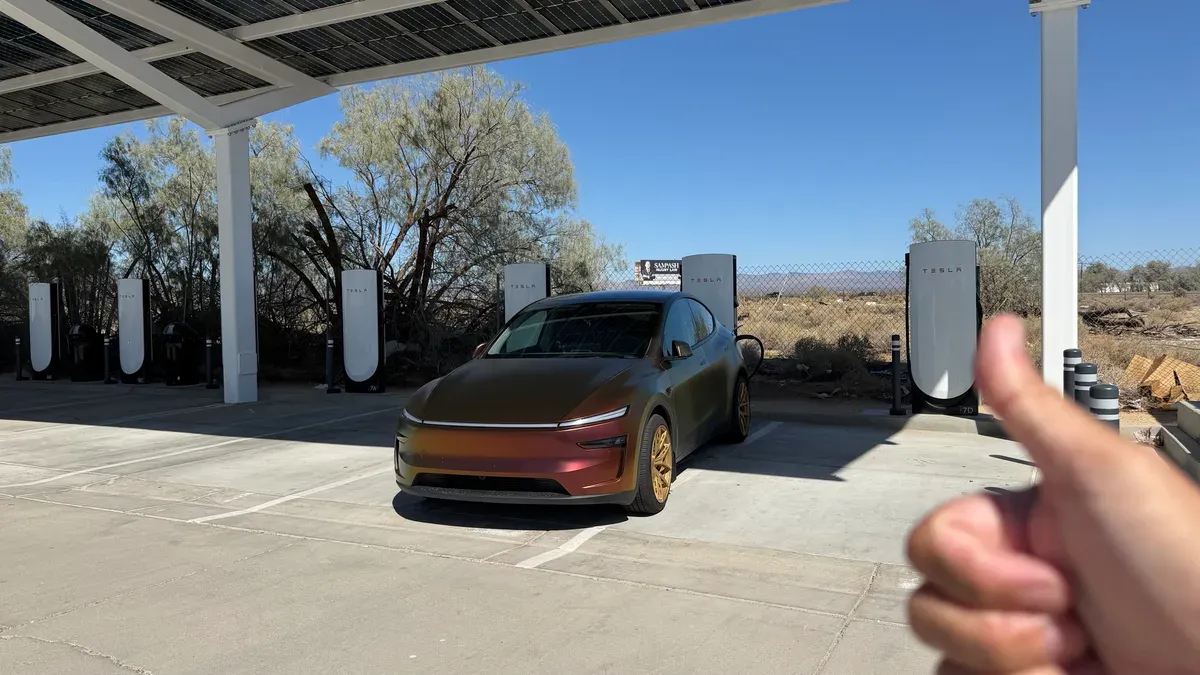
That is why I keep asking the 100% FSD crowd how they are doing it. Either you are only driving simple routes, or you are accepting parking jobs like that one. I am not saying FSD sucks, it is genuinely impressive, but a real road trip with real parking lots is not a 100% drive right now.
Do not pass Baker below 50%
The efficiency story on this route never changes, and it catches people out. Leaving Baker at exactly 50%, with Primm 49 miles away, the car predicted 25% on arrival. I pulled in at 24%.
Do the math on that: a quarter of the battery for 50 miles means a full battery is worth about 200 miles here, not the 300-plus the range estimate implies. Elevation and wind, mostly. The energy app put 4.9% of the loss on a 9.5 mph crosswind out of the southwest, on top of running the AC at 69°F while it was 110°F outside.
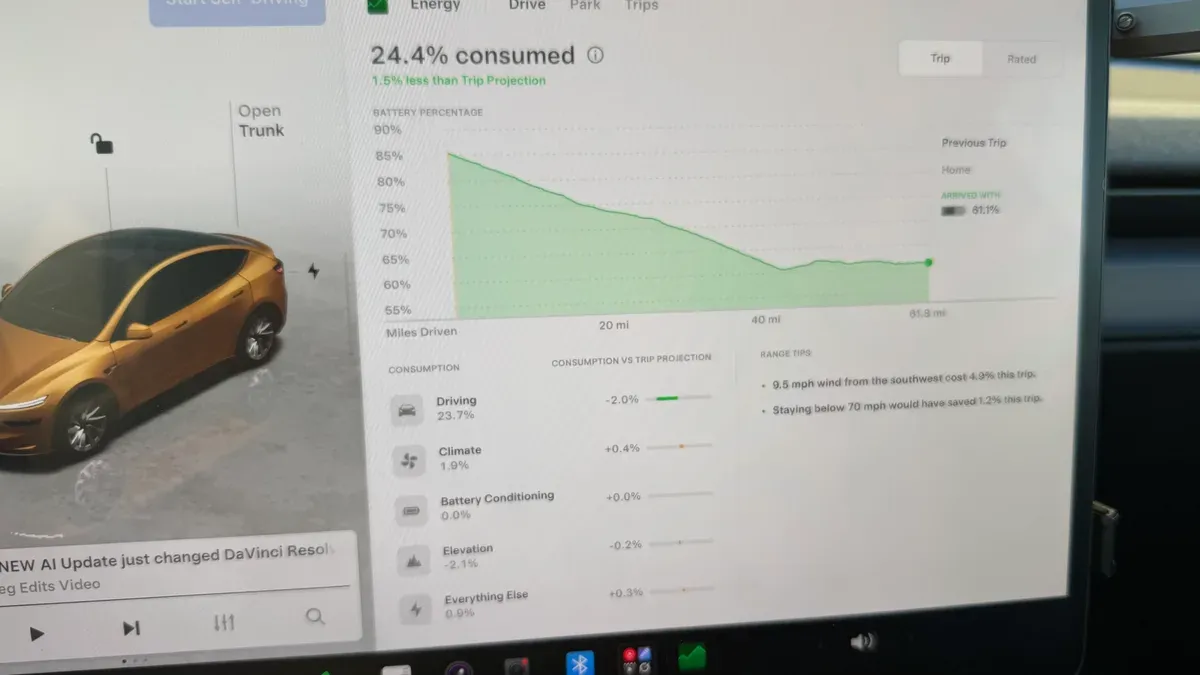
There are no Superchargers in that 50 mile stretch, so the rule stands: leave Baker above 50%. It is not hard to road trip an EV, you just have to plan a little.
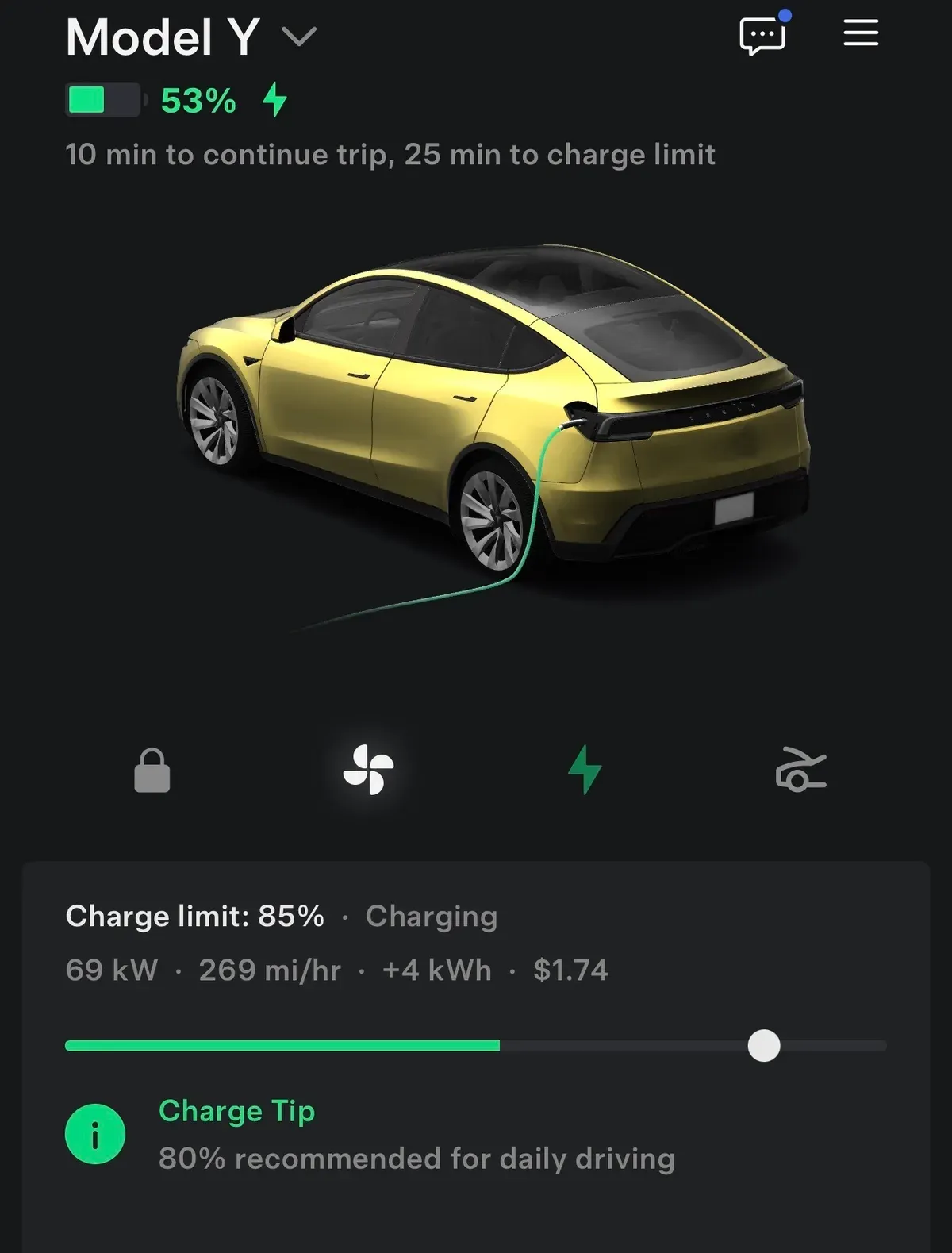
One more charging note, since it costs real money. The rule is simple: on the older 150 kW stalls, paired stalls split the cabinet roughly in half, and at 250 kW and up every stall gets its own power. So at EddieWorld I sat at 70 kW at 65% state of charge when I would have seen around 86 kW alone. The newer V4 Superchargers at Jean are the opposite: I plugged in at 9% and watched it hit 253 kW.
What 532 miles cost
Five stops, 171.82 kWh, 118 minutes plugged in.
| Stop | Speed | kWh added | Per kWh | Cost |
|---|---|---|---|---|
| Yermo (EddieWorld) | 150 kW | 17.32 | $0.44 | $7.62 |
| Primm | 250 kW | 44.70 | $0.47 | $21.01 |
| Jean | 325 kW | 45.21 | $0.49 | $22.15 |
| Baker | 250 kW | 35.25 | $0.45 | $15.86 |
| Barstow | 250 kW | 29.34 | $0.45 | $13.28 |
| Total | 171.82 | $0.46 | $79.85 |
That is $0.15 per mile and a 23.6 minute average stop. Nevada Supercharging at $0.49 per kWh is pricey, and it is worth knowing before you assume an EV road trip is free.
Parked overnight at Park MGM, the car went from 48% to 43% in about 24 hours with Sentry Mode on and no Cabin Overheat Protection. Leave it somewhere between 40% and 50% and you will be fine.
The streak, and Vegas
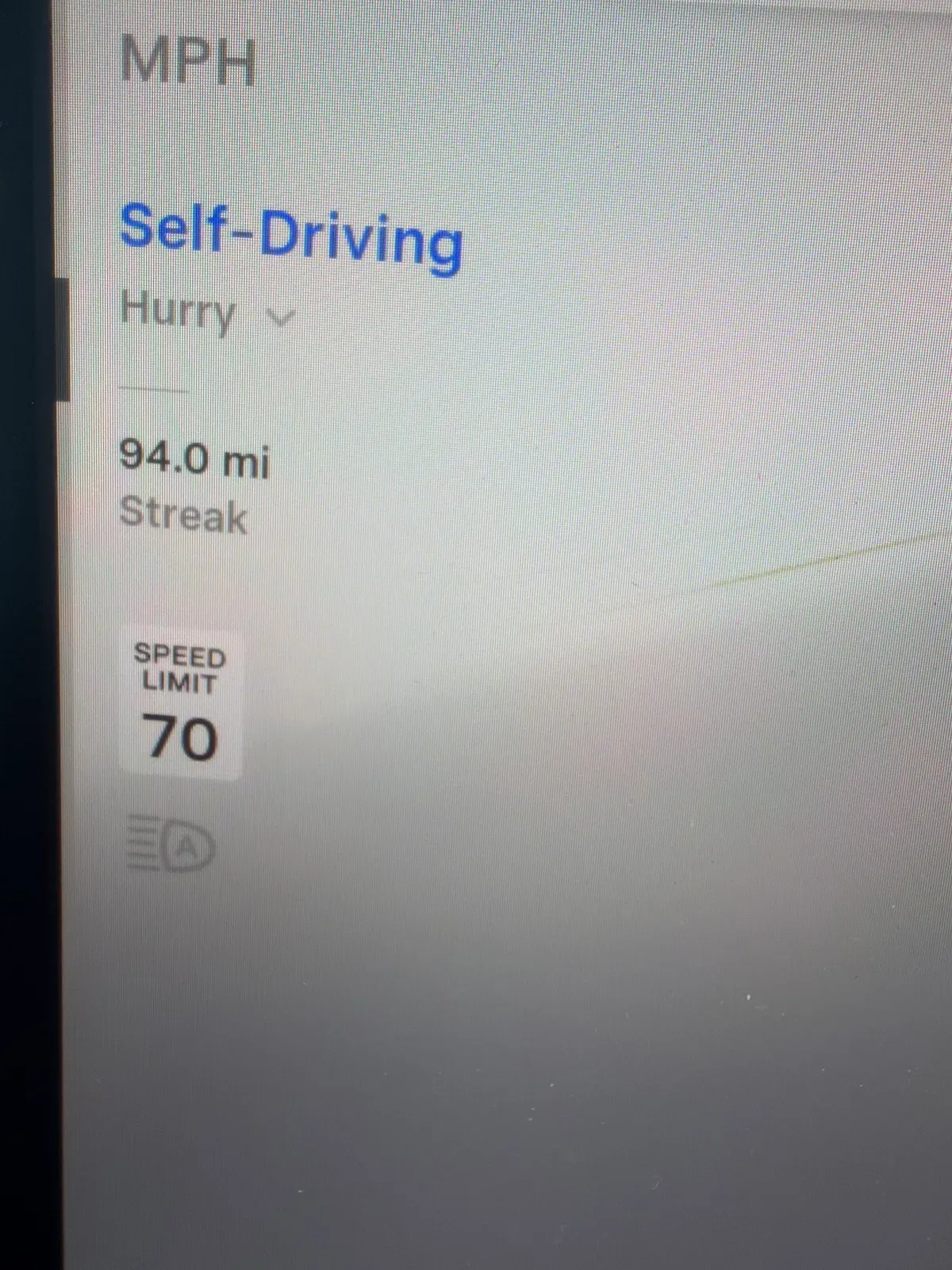
Pulling into Baker I hit a 100 mile FSD streak, only the second time I have done it. I should hit that on a normal workday since I drive over 100 miles, but FSD cannot handle the parking lot entrances at my son’s high school or my job, where it wants a mile-and-a-half detour to the main entrance instead of the back one I actually use. Forcing it would take three waypoints and canceling parking at each one, so I take over instead.
Then it kept going. Backing up manually at Barstow did not reset the counter, and in the dark with about 20 miles left to get home, the screen turned into a confetti cannon: 250 miles.
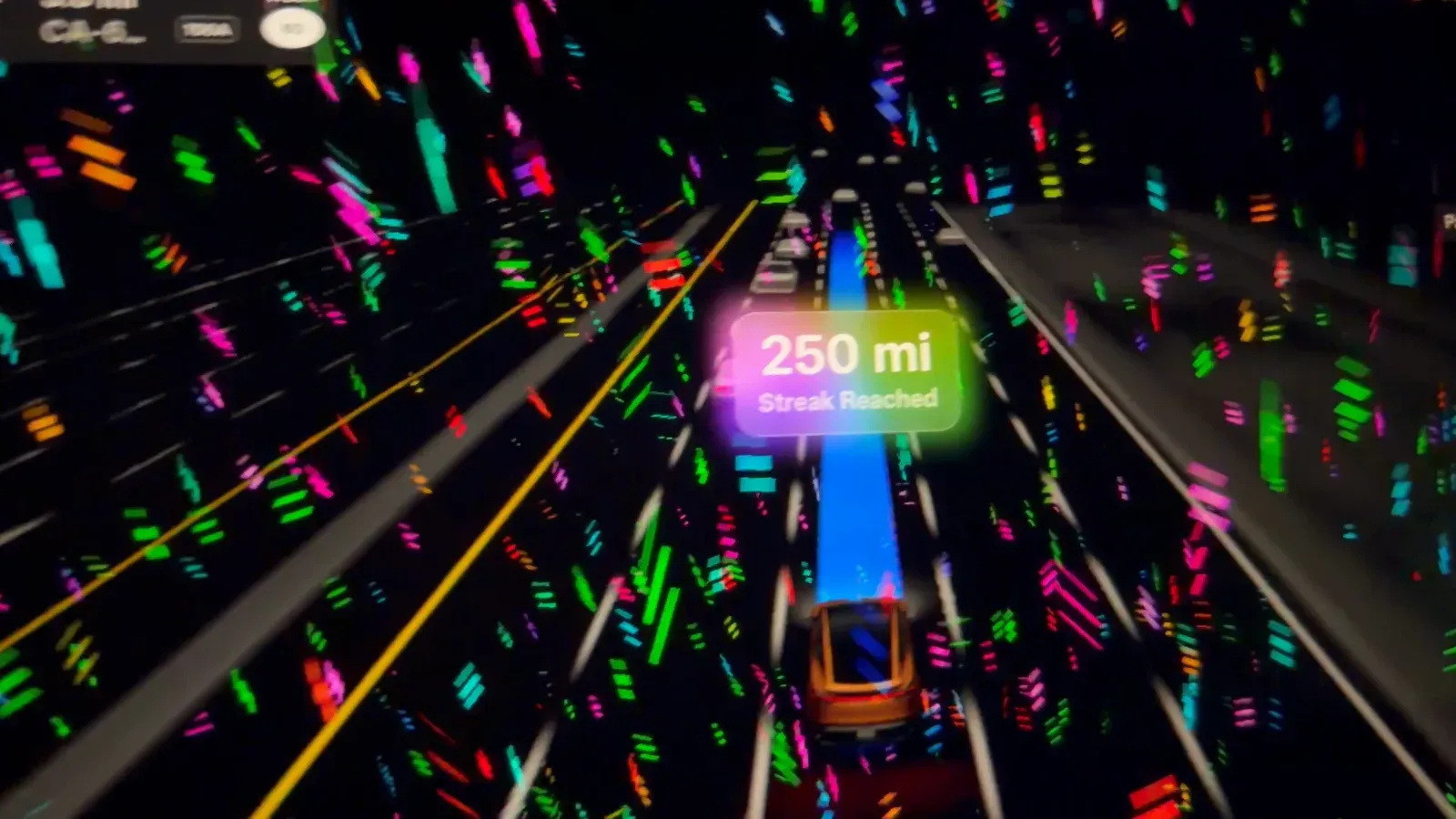
Honestly, I have mixed feelings about the streak counter. It gamifies the drive, and it nudges you toward being a worse supervisor just to protect a number. Two hundred and fifty miles is a genuinely fun thing to see. It is also the reason I hesitated before reversing at Barstow, which is exactly the wrong instinct to build into a driver.
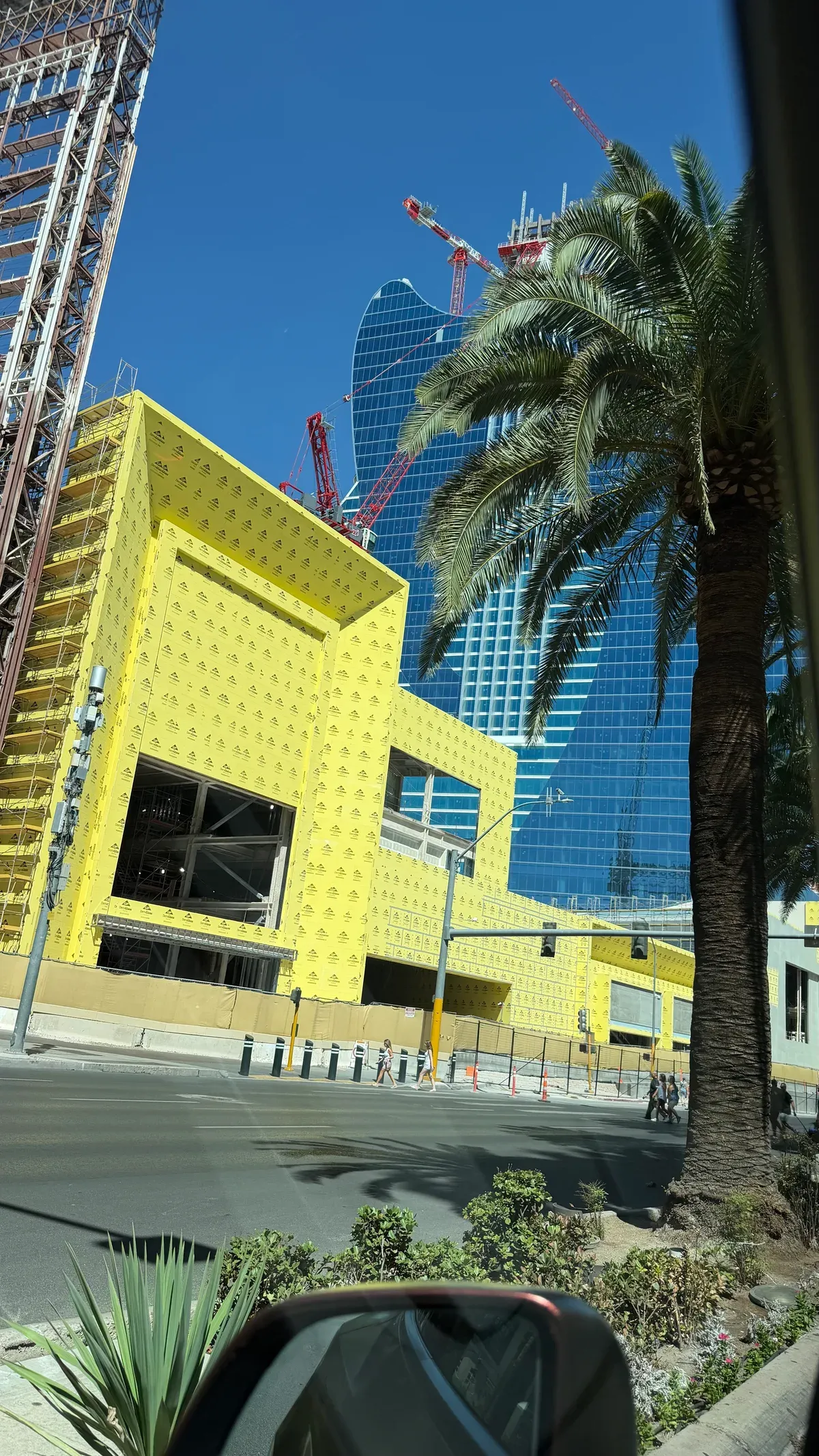
The Vegas part was quick. I picked up my nephew and his wife, Park MGM upgraded us to a suite with exactly one bed, which is not happening with my nephew, so they moved us. The Bellagio Conservatory is done up as a full safari right now, with mechanical elephants that spray water. The old Mirage site is now the Hard Rock going up with the giant guitar.
I also ran into a few guys from Empire Custom Wraps at Primm with three Model 3s, on their way to Vegas too. Holographic wraps, fresh tint, ridiculous wheels. That is the fun of Supercharger stops.
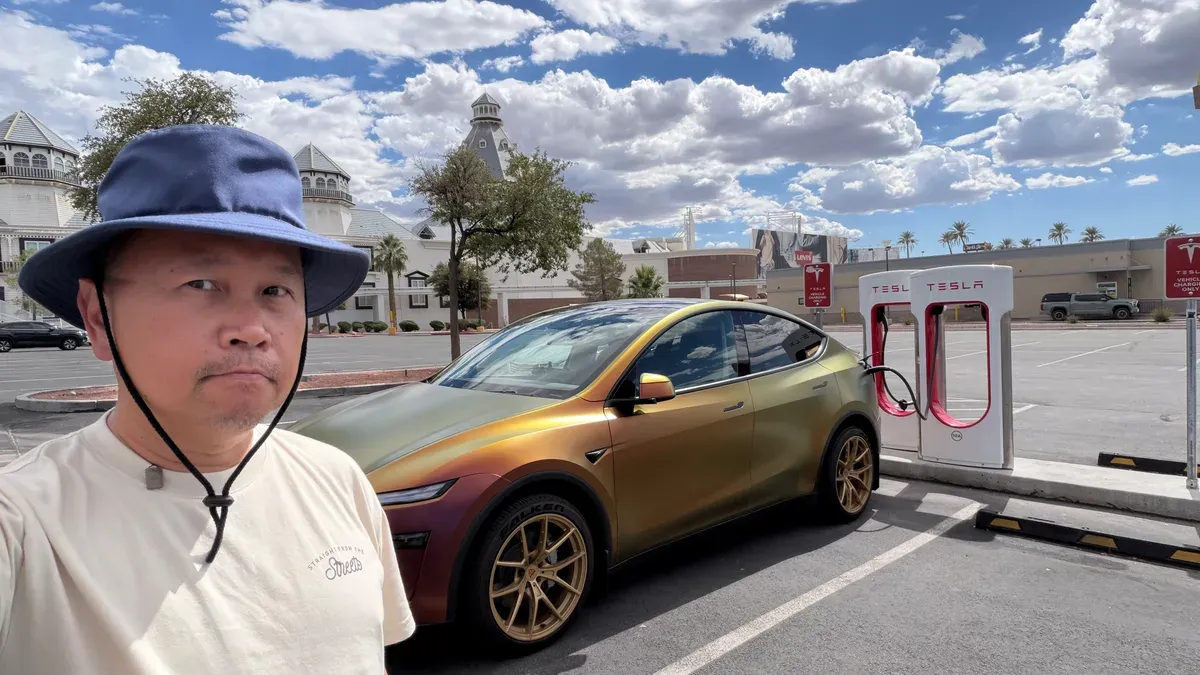
Gear wise, I had the AstroAI tire inflator and the Hansshow powered frunk, which swallowed a carry-on and my camera bag. I also brought a Hansshow 200W inverter to test, which they sent after seeing the V2L adapter refuse to work on my Model Y. That gets its own video. Use coupon SMARTINUP, limited time, restrictions may apply.
So, 98.2%. If you want to try FSD on a Tesla of your own, do the before-and-after photo thing and tell me what you actually get, because I do not believe the 100% numbers. And tell me whether Tesla should keep the streak counter or kill it.
Leave a comment
Comments come straight to me rather than posting publicly, and I read every one. Your email is never published.